
How to Reduce Ecommerce CAC: The Yield Ladder Playbook
If your ecommerce CAC is climbing, the fix isn't cutting ad spend or chasing a new channel. It's diagnosing which of five stages in your acquisition system is leaking. Most ecommerce stores lose 60% of their potential customer yield at one specific stage — and it's not Spend. This playbook walks the five-stage Yield Ladder, shows you the benchmark CAC by vertical, and points you to the fix for your bottleneck stage.
Why most CAC advice fails
The industry talks about ecommerce CAC as if it's a number you can negotiate with by cutting spend or chasing a new channel. You can't. CAC is an output. It's what falls out of five upstream decisions: how much you spend, who you capture, how you convert, whether they come back, and what portfolio they belong to once they do.
Every CAC reduction guide that opens with "test new creative" or "lower your CPM" is solving for the visible line item instead of the system that produces it. Industry analyses — including extensive work by platforms like Insider One on cross-channel personalization — consistently show that acquisition cost is shaped more by what happens after the click than what happens before it. Capture and Repeat are usually where the leak is. Spend is rarely the actual problem.
The Yield Ladder treats CAC as a diagnostic question, not a budget question. Run the ladder, find your lowest broken stage, fix that, and let CAC reprice itself downstream. This pillar is the operating manual for that diagnosis.
The Yield Ladder
The Yield Ladder is five stages. Read top to bottom. Diagnose the lowest stage that's broken — that's your bottleneck. Fixes upstream of a broken stage don't compound; they leak.
Stage 1 — Spend. Dollars deployed against an acquisition channel. The yield question: is the channel structurally capable of returning your target ratio? Most stores are at the wrong channel mix for their stage, not the wrong budget. (See: Channel-Stage Fit.)
Stage 2 — Capture. Visitors who give you a signal — email, account, add-to-cart. The yield question: of the traffic you paid for, what percentage did you keep the right to talk to again? Capture is where 60% of yield is lost and nobody is looking.
Stage 3 — Convert. Captured visitors who place a first order. The yield question: of the visitors you have permission to talk to, how many bought — and at what discount? Convert rate without discount discipline is a vanity number.
Stage 4 — Repeat. First-order buyers who place a second order. The yield question: did the first order earn the right to a second? The single biggest CAC multiplier in the model. A 28% → 38% repeat rate roughly halves effective CAC.
Stage 5 — Portfolio. The mix of behaviors across your customer base — bargain hunters, full-price loyalists, episodic high-ticket. The yield question: are you acquiring the portfolio you want, or the portfolio your discount strategy selects for? (This is where the Customer Yield pillar hands off to Customer Portfolios.)
The rule: fix the lowest broken stage first. A 1-point gain at Capture beats a 10-point gain at Spend, because Capture compounds through the three stages below it.
[og_image: /content/images/og/customer-yield-hub-og.png]
Not Sure Where to Start? A Primer on Driving Customer Yield
You've heard about conversion rate optimization forever. But the equation for CAC is Advertising Expense divided by New Customers. If you want to lower CAC, you can find a way to reduce your ad expense (good luck), or you can increase customer yield with customer generated offers — and not just for ad traffic.
Customer generated offers are architected to deliver insights into your audience: price points for identified customers, inventory you could have sold but opted not to at the time and that is now sitting in clearance, and the opportunity cost of those decisions. It's a powerful tool suite built by retailers, for retailers. Get started here.
Learn About Customer Yield
Understand the denominator inside CAC and why producing more customers from the traffic you already have is the durable path to acquisition efficiency.
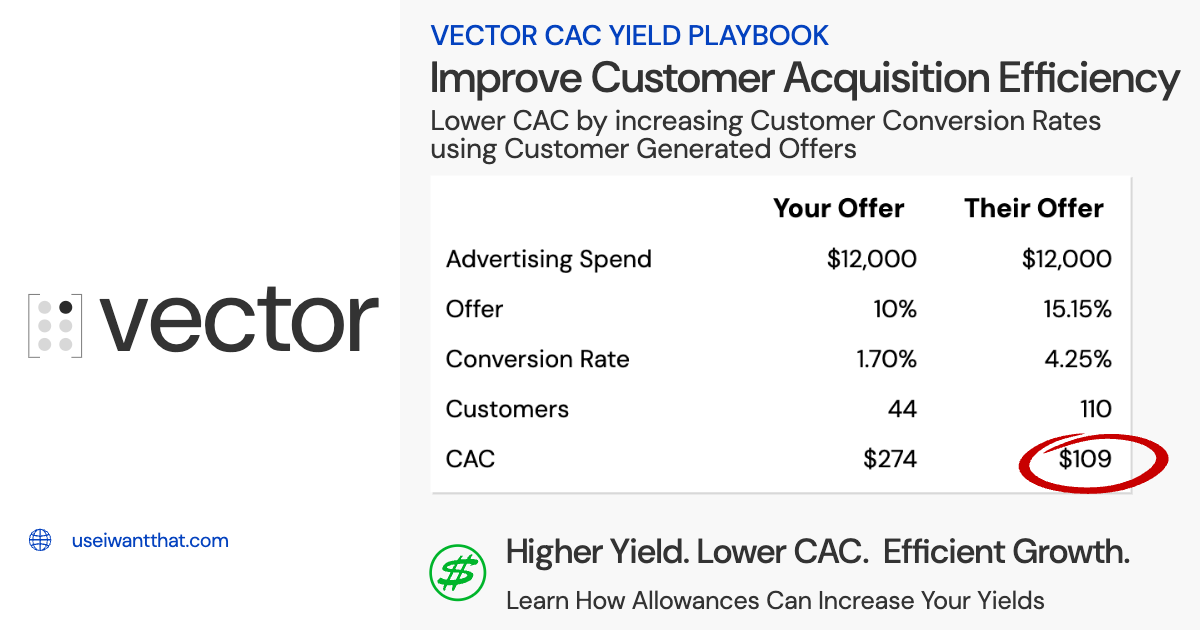
Check Out Our Customer Yield Playbook
Move from diagnosis to action with a practical plan for improving acquisition economics and converting more of your existing traffic.
Suggested content for your DTC journey
Explore the operating topics that connect acquisition spend to profitable, repeatable growth. Each resource includes a glossary frame of reference for the core idea.

Channel Assessment
Assess whether your acquisition channels can produce the return your store needs before committing more budget.
Customer Capture
Replace low-intent list building with signals and experiences that retain the right visitors and create a path to purchase.
Customer Yield
Learn how to acquire more customers from the same spend by improving the productive side of the CAC equation.

Repeat Buyers
Build the second-order path that turns first-time acquisition into a durable customer relationship and improves effective CAC.
Strategic Customer Portfolio Management
Manage customers by behavior and value so acquisition, retention, and promotional investment support profitable growth.
Looking at Scaling?
Check out additional content to help you drive profitable growth.

Markup Performance
Build a defended price floor and fund the five allowances that let your retail price flex without silently giving away profit.
Customer Portfolio Management
Identify which customers to acquire, retain, grow, reactivate, or win back based on observed purchase behavior and value.
Negotiated Commerce
Learn the operating model behind customer-generated offers, margin-safe price flexibility, and commerce built around mutual value.
FAQ
How do I reduce my CAC in ecommerce? The fastest CAC reduction in most ecommerce stores doesn't come from cutting spend or testing new creative. It comes from fixing Stage 2 (Capture) or Stage 4 (Repeat) of the Yield Ladder. A 5-point gain in Capture Rate or a 10-point gain in Repeat Rate produces a larger CAC reduction than a 30% spend cut, without losing volume. Diagnose first, then deploy the fix.
What is a good CAC for an ecommerce store? There is no single good CAC — it depends on vertical, AOV, margin, and repeat rate. Apparel runs $25–$60, supplements $30–$70, home goods $40–$120, considered purchases ($500+ AOV) can absorb $150–$300. The better question: is your CAC less than 30% of your customer's two-year contribution margin? If yes, you're fine. If no, you have a yield problem somewhere on the ladder.
Why is my CAC going up? Three causes account for 90% of ecommerce CAC inflation since 2023: Meta auction costs are up structurally, Apple ATT degraded targeting precision (especially for stores under $1M revenue), and Capture Rate has quietly collapsed across most stores as third-party retargeting got harder. The first is industry-wide. The second and third are fixable on your store.
What is customer yield? Customer Yield is the return a store earns on every dollar spent acquiring a customer, measured across five stages: Spend, Capture, Convert, Repeat, Portfolio. Unlike CAC — which is a single output number — yield is diagnostic. It tells you which stage of the acquisition system is leaking.
How is customer yield different from LTV:CAC? LTV:CAC is a ratio of two endpoints. Yield is the system between them. Two stores with identical LTV:CAC ratios can have completely different ladder profiles — and completely different fixes. The ratio tells you whether you have a problem; the ladder tells you where.
Which stage of the Yield Ladder usually breaks first? For ecommerce stores in the $100K–$5M band, Capture and Repeat are the two most common breaks. Spend gets the attention because it's the line item operators see every morning. Capture and Repeat get ignored because they don't show up as a single number — they show up as a slow leak.
Do I need to fix all five stages? No. Run the calculator, find your lowest broken stage, read those cluster posts. The point of the ladder is to give you one diagnosis, not five projects.
How often should I re-run my yield diagnosis? Quarterly, and any time CAC moves more than 15% in a month. The ladder is a system, and systems drift.